 Georgia Cost Guide
How much does concrete work cost in Georgia?
Estimated price ranges per square foot for a concrete slab, a driveway, a patio and stamped concrete, from the cost estimates Georgia concrete contractors publish, plus what moves the price of each pour.
The short answer
We checked 185 Georgia concrete contractor websites.
Concrete slab
$9 to $10+ per sq ft
Prices from 5 Georgia concrete contractors
Concrete slab: what goes into itConcrete driveway
$9 to $12+ per sq ft
Prices from 7 Georgia concrete contractors
Concrete driveway: what goes into itConcrete patio
$11 to $12+ per sq ft
Prices from 5 Georgia concrete contractors
Concrete patio: what goes into itThese are typical ranges per square foot, not quotes, and they come from the cost estimates contractors publish rather than price lists. Tearing out old concrete, ground preparation and reinforcement often change the price, and the sections below explain how. The dot marks the middle price, and a + means some businesses charge more. Where a job has no range, it's because we only show a price once enough Georgia businesses publish one.
 Concrete slab
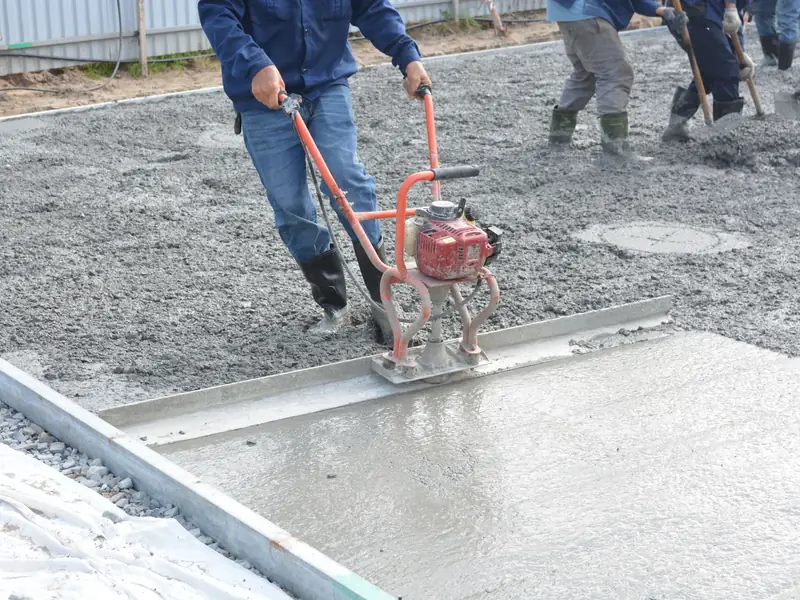
A concrete slab is a flat pad poured on the ground, for a shed, a garage floor, a carport or a base for equipment. The range is a price per square foot, so ask what thickness and what base the price assumes. A coating on top, such as epoxy on a garage floor, is flooring work; see what an epoxy floor coating costs.
The range for this job is in the short answer above.
What moves the price
- Thickness
- A thicker slab uses more concrete for every square foot, so asking for extra thickness raises the price.
- Steel or fiber
- Wire mesh, rebar or fiber mixed into the concrete each add to the price, and the heavier the load, the more reinforcement a contractor may suggest.
- Ground preparation
- Clearing, leveling and packing a gravel base under the slab is part of the work, and sloped or soft ground takes more of it.
- Getting the concrete there
- When the mixer truck can back up to the forms, the pour goes faster. A slab behind the house or past a fence may need a pump truck or wheelbarrows, which add to the price.
- Size of the pour
- Setup and delivery cost about the same for a small pad as for a larger one, so a small slab often costs more per square foot.
Concrete driveway
A concrete driveway is a slab built to carry cars, poured with a slope so water runs off. The range is per square foot, and replacing an old driveway usually adds breaking up and hauling away what is there.
The range for this job is in the short answer above.
What moves the price
- Tear-out
- Breaking up and hauling off the old surface is extra work, so a replacement usually costs more per square foot than a new driveway on bare ground.
- Length and shape
- Curves, a turnaround or a wide flare where the driveway meets the street take more forming than a straight run, which raises the price.
- Slope of the lot
- A steep driveway can need more grading, more base and a finish with more grip, which raises the price.
- The apron at the street
- The section where the driveway meets the street can have its own rules, so ask whether your city or county requires a permit or an inspection for it.
- Finish and borders
- A broom finish is the usual surface for traction. Exposed aggregate, color or a decorative border adds to the price.
Concrete patio
A concrete patio is a slab beside the house for outdoor seating. The range is for a plain patio per square foot; stamped and colored patios are priced in the stamped concrete section below.
The range for this job is in the short answer above.
What moves the price
- Shape and curves
- A plain rectangle forms fastest. Curved edges, cutouts around trees and more than one level take more forming and raise the price.
- Steps and seat walls
- Steps down to the yard, a seat wall or a raised fire pit area add their own work on top of the slab price.
- Plain or decorative
- The range is for a plain finish. Stamping, color or exposed aggregate raise the price per square foot.
Stamped concrete
Stamped concrete is pressed with patterned mats while it is still wet, then colored and sealed to look like stone, brick, slate or wood. The extra labor and materials put it above plain concrete per square foot.
Stamped concrete
$11 to $17+ per sq ft
Prices from 6 Georgia concrete contractors
Stamped concrete: what goes into itWhat moves the price
- Pattern and detail
- A single all-over pattern costs less than a border in a second pattern, a medallion or hand-detailed joints.
- Number of colors
- A base color plus a release color that darkens the low spots is common. More colors and hand staining add labor.
- Crew on pour day
- Stamping has to be done while the concrete is setting, so a large stamped area can call for a bigger crew, which raises the labor cost.
- Sealer and upkeep
- A sealer brings out the color and protects the surface. Ask whether the first coat is in the price and how often the contractor suggests resealing.
Concrete by the yard
Ready-mix concrete is sold by the cubic yard and delivered in a mixer truck, whether you pour it yourself or a contractor orders it for the job. We do not have a Georgia range for delivered concrete yet.
No Georgia range for this job yet. Here is what moves the price. Get a quote
What moves the price
- Short load fees
- Concrete plants often charge an added fee for a load well below a full truck, so a small order can cost more per yard.
- Mix and additives
- A stronger mix, fiber, or an additive that speeds or slows setting in cold or hot weather each change the price per yard.
- Time at the site
- The price usually allows a set amount of unloading time, and a truck kept waiting longer can be billed for it.
- Delivery distance
- A site far from the plant can carry a delivery or fuel charge.
Slab foundation
A slab foundation is the concrete base a house or an addition sits on, with footings or thickened edges under the walls and plumbing set in the ground before the pour. It is usually designed for the building and quoted by the job, and there is no Georgia range here yet.
No Georgia range for this job yet. Here is what moves the price. Get a quote
What moves the price
- Footings under the walls
- The footings that carry the walls take more digging, steel and concrete than the open floor area, so more walls and corners raise the price.
- Plumbing in the ground
- Drain lines have to be set before the pour, often by a plumber, and that work may be priced separately.
- Soil and fill
- Soft fill, heavy clay or a sloped lot can call for more fill, compaction or a stepped design, which raises the price.
- Plans and inspections
- Ask whether the quote follows an engineer's plans, and whether your city or county inspects the forms and steel before the pour.
Sidewalks and walkways
A sidewalk or walkway is a narrow strip of concrete, such as the path from the driveway to the front door. There is no Georgia range for walkways yet.
No Georgia range for this job yet. Here is what moves the price. Get a quote
What moves the price
- Narrow and long
- A walkway takes a lot of forming for its area, so it can cost more per square foot than a wide slab.
- Curves and connections
- A curved path, or one that ties into steps, a porch or the driveway, adds forming and joint work.
- Sidewalks along the street
- Replacing the public sidewalk in front of a house may involve the city or county, so ask who is responsible for it and whether a permit is needed.
Concrete steps
Concrete steps are formed and poured in place at a door, a porch or a slope in the yard. Each step is formed by hand, so steps are often quoted by the job rather than by the square foot, and there is no Georgia range for them yet.
No Georgia range for this job yet. Here is what moves the price. Get a quote
What moves the price
- Number of steps
- Each added step means more forming and more concrete.
- Landings and width
- A landing at the top or a wider set of steps adds concrete and forming.
- Handrails
- A rail set into the concrete is often a separate item, so ask whether it is included.
Concrete removal
Concrete removal means breaking up an old slab, driveway or patio and hauling it away. It is often part of a replacement quote, and there is no Georgia range for removal on its own yet.
No Georgia range for this job yet. Here is what moves the price. Get a quote
What moves the price
- Steel inside
- Concrete with rebar or wire mesh takes longer to break apart and separate, which raises the price.
- Hauling and disposal
- Broken concrete is heavy, and the truck trips and dump fees add to the price. Some contractors take it to a recycler instead.
- Room for a machine
- A machine that can drive up to the slab works faster than breaking it by hand behind a fence or in a tight backyard.
Concrete repair and leveling
Repair covers patching cracks and broken edges and resurfacing a worn top. Leveling lifts a sunken slab by pumping material under it, either a cement slurry, often called mudjacking, or expanding foam. There is no Georgia range for these yet.
No Georgia range for this job yet. Here is what moves the price. Get a quote
What moves the price
- Mudjacking or foam
- The two lifting methods are priced differently, so ask which one a quote is for and why the contractor suggests it.
- Cause of the damage
- Cracks from roots, poor drainage or washed-out soil can come back unless the cause is fixed, and fixing it adds to the job.
- Repair or replace
- Patching and lifting usually cost less than a new slab, but badly broken or crumbling concrete may not hold a repair, so ask the contractor which they suggest and why.
What a good concrete quote should list
Two concrete quotes for the same area can look far apart until you see what each one includes. Ask each contractor to put these in writing:
- Exactly which job the price covers, and the square footage it is based on
- The thickness of the concrete and the reinforcement: wire mesh, rebar or fiber
- Whether tearing out and hauling away old concrete is included
- What ground preparation is included, such as grading, the gravel base and compaction
- The finish, and whether stamping, color and the first coat of sealer are in the price
- Whether a pump truck or extra labor to reach the site is included
- Who handles any permit or inspection your city or county requires, and whether its fee is in the price
- Whether the contractor offers a warranty, and what it says about cracks
Where these numbers come from
We collect these prices with our own crawler, which reads the public websites of Georgia concrete contractors and follows each site's robots.txt rules. It has read 185 of their websites so far. Each range is the middle half of the prices and cost guides those businesses publish, collected November 2026. A price list is what a business says it charges; a cost guide is a business's own estimate of what the job usually runs in Georgia. We check every figure against the page it came from, leave out national averages and prices from other states, and count a business only once, even if it has several websites. We never name the businesses behind a range. This page is written and published by Georgia SEO Company.
| Job | Businesses that post a price |
|---|---|
| Concrete slab | 5 (all cost guides) |
| Concrete driveway | 7 (all cost guides) |
| Concrete patio | 5 (all cost guides) |
| Stamped concrete | 6 (all cost guides) |
Get a concrete quote
Tell us about the project. Georgia Cost Guide will reach out the way you prefer and help you get a quote from a Georgia concrete contractor.
Concrete guides
Answers to the questions Georgia homeowners ask about concrete work.